The Transport Engineer
A discipline built at the intersection of movement, people, and cities
Somewhere between the Roman road engineer calculating the gradient of a mountain pass and the data scientist optimizing a real-time bus network in Singapore, there is a profession. The boundaries between the profession and neighboring disciplines — urban planning, civil engineering, economics, geography, computer science — are genuinely blurry, and that blurriness is not a defect. It is a reflection of the problem itself.
Transport engineering is a discipline defined not by its tools or its methods, but by its object: the movement of people and goods through urban and regional space, and the infrastructure, systems, and policies that make that movement possible. Everything else such as the mathematics, the models, the software, the fieldwork, etc... is in service of that object. Understanding what the discipline is, where it came from, and what it demands of the people who practice it seriously is the starting point for everyone who aims to work with it.
A discipline born from urgency
As we traced in the previous essays, transport engineering did not emerge from a theoretical tradition. It emerged from the pressure of real cities with real, urgent, and politically loaded problems. The industrial city produced congestion, inequality, and mortality at a scale that demanded systematic response. The railway required surveyors, structural engineers, and operations managers. The tram network required electrification engineers and route planners. The automobile required road designers, signal controllers, and eventually traffic analysts capable of modeling the behavior of millions of vehicles simultaneously.
Each of these demands pulled professionals from neighboring fields (e.g., civil engineering, mathematics, economics, geography) and asked them to apply their tools to a new set of problems. The discipline that eventually coalesced around those problems was eclectic by necessity. It borrowed the structural analysis of civil engineering, the optimization methods of operations research, the behavioral models of economics and the human psychology, and the spatial reasoning of geography. It has never fully settled into a single intellectual identity, and probably never will.
What it did settle into, in the mid-20th century, was a particular set of priorities — and, as we noted in the previous essay, a particular bias. The traffic engineering tradition that dominated the field from the 1950s onward was built around a specific question: how do we move more vehicles faster? That question produced powerful methods such as capacity analysis, signal timing optimization, highway design standards that remain central to the discipline today. But it also produced a generation of professionals trained to measure success in vehicle throughput and level of service, rather than in the quality of access the transport system provided to the full range of people who depended on it.
The history of transport engineering is, in part, a history of a discipline learning to ask better questions — and discovering that the answers it had optimized for were sometimes answers to the wrong problem.
That reckoning began in the 1970s and has accelerated since. The energy crises, the environmental movement, the rediscovery of urbanism, the rise of public health research connecting transport to physical activity and air quality, the computational revolution that made new kinds of analysis possible. All of these have pushed the discipline to expand its frame. The transport engineer of the 21st century is not simply a traffic engineer with better software. She or he is a professional who must understand movement as a system embedded in a city, an economy, an environment, and a political reality simultaneously.
What transport engineers actually do
The simplest answer is: they solve problems of access and movement. But that answer obscures more than it reveals, because the problems of movement in a contemporary city are so varied, so technically demanding, and so deeply entangled with non-technical considerations that no single professional can master all of them. Transport engineering is, in practice, a family of specializations that share a common object but differ substantially in their methods, their data, and their professional culture.
A traffic engineer designing signal timings for a busy intersection and a transport economist modeling the demand effects of a new metro fare policy are both transport engineers in the broad sense. So is the GIS analyst mapping accessibility gaps in a metropolitan area, the operations researcher optimizing a bus network timetable, the road safety engineer auditing a highway design, and the infrastructure planner sizing a new terminal for a growing airport. What connects them is not the same set of tools but the same fundamental question: how does movement and access — or the absence of it — shape the lives of the people in a city?
The landscape of the discipline
The map below organizes the main areas of transport engineering around a central hub. Each area represents a distinct domain of knowledge and practice — with its own methods, literature, and professional community. No single engineer masters all of them. But every serious transport professional needs to understand where each area sits in relation to the others, and how decisions made in one domain propagate through the rest of the system.
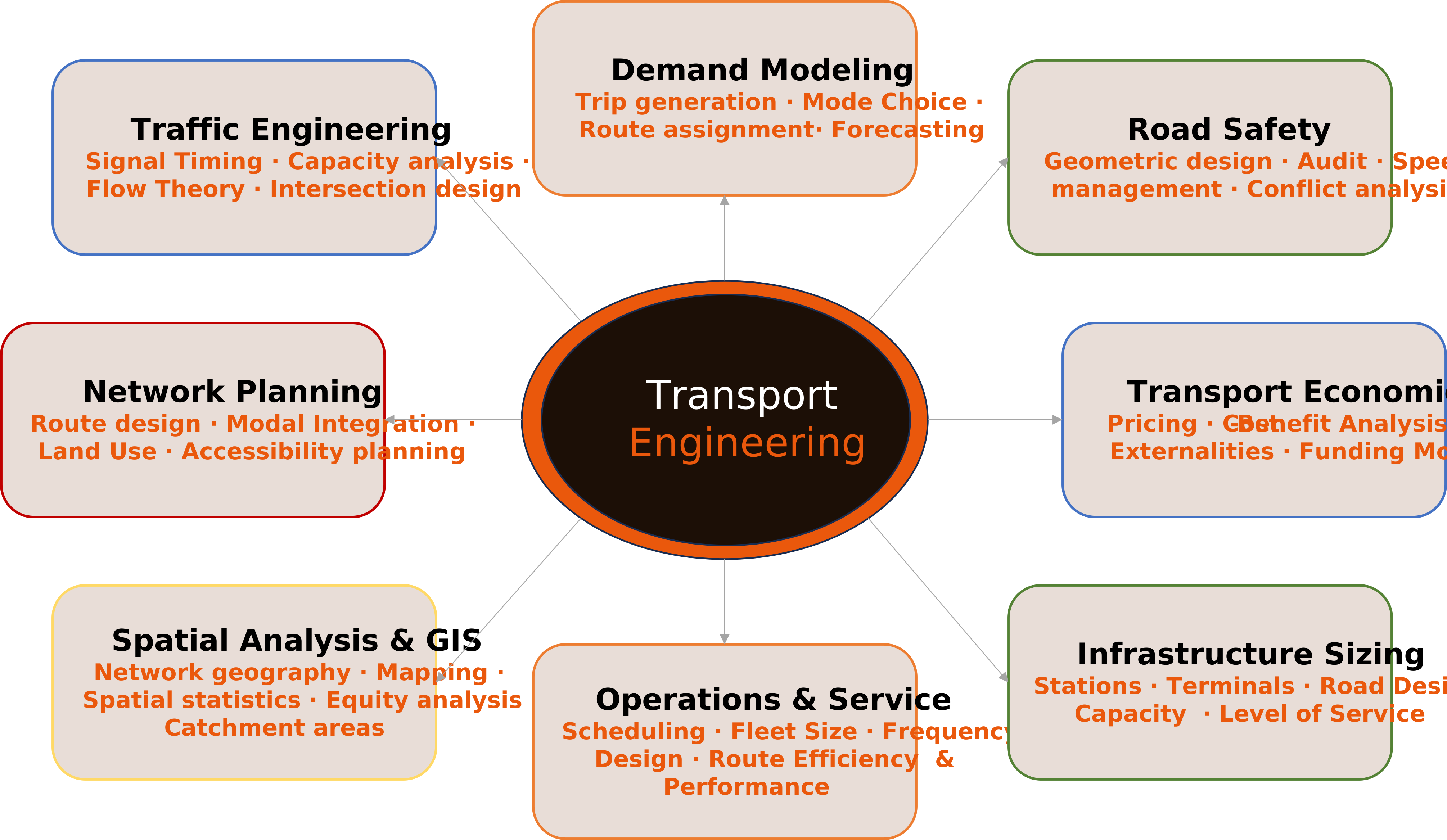
A few observations about this map are worth making explicit. First, the areas are not independent. A demand model is useless without a network to model; a network plan is irresponsible without an economic appraisal; an infrastructure design is incomplete without a capacity analysis rooted in demand forecasts. The connections between nodes are as important as the nodes themselves — and one of the most common failure modes in transport practice is optimizing within one area while ignoring the effects on others.
Second, the map does not show a hierarchy. Demand modeling is not more important than road safety; GIS is not subordinate to transport economics. Each area has its own depth, its own literature, and its own professional community. What the map does show is a family of problems that share a common parent and that require each other to produce complete answers.
A brief tour of the core areas
Traffic engineering and flow theory
This is the area most closely associated with the 20th-century tradition: the analysis of vehicle flow on roads and intersections, the design of signal systems, the calculation of capacity and delay. It is deeply quantitative — rooted in fluid dynamics analogies, queuing theory, and empirical observation of driver behavior. It remains essential, but its scope has broadened: modern traffic engineering increasingly addresses pedestrian and cyclist flows, multimodal intersections, and the integration of real-time data from connected vehicles.
Demand modeling
How many people will use a new metro line? What happens to bus ridership if fares increase by 20%? How will travel patterns change if a new employment center opens on the urban periphery? These are demand modeling questions — and answering them rigorously requires a combination of statistical analysis, behavioral economics, and computational modeling that places demand modeling at the technical frontier of the discipline. The classical four-step model (trip generation, distribution, mode choice, assignment) remains the workhorse of professional practice, but it is increasingly supplemented — and in some contexts replaced — by activity-based models and agent-based simulations.
Network planning and accessibility
Where should a new bus line run? Which communities are underserved by the current network? How should transfers between modes be organized to minimize total travel time? Network planning combines spatial analysis, optimization, and political judgment in ways that make it one of the most complex areas of the discipline. It is also the area where the shift from mobility to accessibility as the primary objective has been most consequential: designing a network to maximize vehicle speed is a fundamentally different problem from designing it to maximize the range of destinations reachable by the median user within a given time budget.
Transport economics
Transport decisions involve large sums of public money, significant externalities — congestion, emissions, noise, accidents — and distributional consequences that are rarely visible in purely technical analyses. Transport economics provides the tools to make these effects explicit: cost-benefit analysis, pricing theory, externality valuation, and the analysis of funding and financing mechanisms. It is also the area most directly connected to policy: the transport economist who can demonstrate that road pricing reduces congestion while funding transit improvements is, in a meaningful sense, doing more to shape the city than the engineer who designs the road.
Spatial analysis and GIS
Transport is inherently spatial: origins and destinations are places, routes are lines through space, and the relationship between transport access and land use is one of the central regularities of urban geography. Geographic Information Systems have transformed the discipline's capacity to analyze these spatial relationships at scale — enabling equity analyses that identify which populations lack access to jobs, hospitals, or schools within reasonable travel times, and network analyses that reveal the structural vulnerabilities of transport systems.
Operations and service design
A bus network on paper is not a bus network in practice. Translating a route plan into a functioning service requires scheduling — determining how many vehicles run, at what frequencies, at what times of day — and fleet sizing, driver rostering, and operational performance monitoring. This area is deeply mathematical (optimization models with thousands of variables) and deeply practical (a timetable that looks optimal on paper may be inoperable given the realities of traffic, driver breaks, and depot locations).
Infrastructure sizing and design
How large does a new metro station need to be? How many platforms should a terminal have? What lane configuration minimizes delay at a signalized intersection? Infrastructure sizing translates demand forecasts into physical dimensions — and errors in either direction are costly. Oversizing wastes public money; undersizing produces the chronic overcrowding that degrades service quality and eventually drives passengers away.
What the profession demands
The range of areas described above implies a corresponding range of skills — and no individual masters all of them. But there is a core of competencies that any serious transport professional needs, regardless of specialization.
Mathematical and statistical reasoning is non-negotiable. Transport engineering is a quantitative discipline. Demand models are statistical models. Capacity analysis is applied calculus and probability theory. Cost-benefit analysis requires fluency in discounting and present value. The engineer who cannot follow the mathematics of the models she uses — who treats them as black boxes to be fed inputs and trusted outputs — is not practicing engineering. She is practicing cargo-cult engineering, and the results tend to reflect it.
Computational fluency has become equally essential. The datasets that modern transport practice generates — GPS traces, smart card records, mobile phone data, vehicle counts — are large enough that they cannot be analyzed without programming. Python has become the lingua franca of transport data analysis, supplemented by R for statistical work and SQL for database querying. This is not a peripheral skill. It is increasingly the core of what distinguishes a transport professional who can work with contemporary data from one who cannot.
Spatial reasoning — the ability to think in maps, to understand how geometry shapes movement, and to analyze the relationship between transport networks and land use — is a skill that develops with practice and does not reduce to any single tool. GIS software is the instrument; spatial reasoning is the underlying capacity.
Systems thinking — the ability to hold multiple interacting components in mind simultaneously, to trace consequences across the boundaries between areas, and to resist the temptation to optimize one variable while holding everything else constant — is perhaps the most important and the hardest to teach. It is the skill that separates the engineer who solves the problem she was given from the engineer who asks whether she was given the right problem.
Where transport engineers work
The areas of knowledge described above are deployed in very different institutional contexts — and the context shapes the work as much as the technical content does. Understanding where transport engineers practice, and what each setting demands, is as important as understanding what they know.
Consulting is where the largest share of transport professionals work globally. Consulting firms, ranging from large multinational engineering companies to small specialized practices, are hired by governments, developers, and operators to conduct studies, design projects, and evaluate policies. The consulting engineer works under contract, on defined deliverables, with timelines and budgets that are rarely generous. The skill premium in consulting is speed and communicability: the ability to produce rigorous analysis efficiently and translate it into recommendations that a non-technical client can act on. The risk is the opposite of depth: the pressure to deliver conclusions before the analysis fully supports them.
Public sector practice takes two distinct forms. The career technical officer, i.e., the engineer embedded in a transport authority, a metropolitan planning agency, or a ministry, is responsible for the institutional continuity of transport planning: maintaining the models, managing the data, reviewing proposals, and ensuring that technical standards are applied consistently across projects and administrations. This role is less visible than consulting but arguably more consequential: the career officer is there before the consultant arrives and after she leaves, and the quality of her work determines whether the city's transport decisions accumulate into a coherent system or a sequence of isolated interventions. The public manager, by contrast, operates at the intersection of technical and political authority. She or he is responsible not only for the quality of analysis but for the organizational capacity to implement it, manage contracts, and navigate the bureaucratic and political environment in which transport decisions are made.
Political and advocacy roles sit at the far end of the spectrum from technical practice, but they are roles that technically trained professionals are uniquely positioned to fill. The elected official or appointed secretary who understands transport planning can ask better questions, resist worse answers, and make more defensible decisions than one who cannot. The advocate working for a cycling organization, a housing justice coalition, or a pedestrian safety group who understands the technical language of transport analysis can engage the planning process on its own terms, and challenge it when the analysis conceals assumptions that deserve scrutiny. Technical knowledge, in these roles, is not a substitute for political judgment. It is a precondition for exercising it credibly.
Third sector and research organizations Think tanks, NGOs, universities, and independent research institutes occupy a different position: producing knowledge and analysis that is not tied to a specific project or a specific client. The transport researcher at a university or policy institute has a freedom that neither the consultant nor the public officer typically enjoys: the freedom to ask inconvenient questions, to challenge prevailing methods, and to publish findings that complicate official narratives. That freedom comes with its own constraints: the pressure to publish, to attract funding, and to translate research findings into a form that practitioners can actually use.
Software and technology development has become, in the last decade, one of the most consequential areas of transport practice and one of the least recognized by traditional professional frameworks. The engineers and data scientists who build the routing algorithms behind navigation apps, the optimization engines behind ride-hailing platforms, and the simulation tools used by planning agencies are making decisions that shape the travel behavior of millions of people. They are, in a meaningful sense, practicing transport engineering — often without the professional formation, the institutional accountability, or the regulatory oversight that traditional transport practice involves. As the boundary between transport infrastructure and digital platform continues to blur, this is one of the most important gaps in the discipline's self-understanding.
The same technical formation leads to very different careers depending on where it is deployed. What unifies them is not the institutional setting but the underlying question: how does access and movement — or the absence of them — shape the lives of the people in a city?
The decision is never purely technical
There is a persistent and seductive illusion in engineering that technical analysis, rigorously conducted, produces correct answers and that correct answers, clearly communicated, will be adopted. Transport engineering has spent decades learning, at considerable cost, that this illusion is dangerous.
Transport decisions are political decisions. The choice of where to build a metro line is not only a question of demand. It is a question of whose neighborhoods get connected, whose property values rise, and whose communities get displaced by construction. The choice of whether to price road use is not only a question of congestion management. It is a question of who pays, who benefits, and which political coalition is willing to bear the electoral cost of a policy that most economists agree is efficient and most voters instinctively distrust. The choice of how to allocate street space between cars, buses, cyclists, and pedestrians is not only a question of throughput. It is a question of values, of what kind of city we want to live in, and of who has the power to decide.
The transport engineer who believes her or his job ends when the technical analysis is complete has misunderstood her job. The analysis is the beginning of the decision process, not its conclusion.
This does not mean that technical analysis is unimportant, quite the opposite. Rigorous analysis is the engineer's contribution to a decision process that involves many other actors: politicians, community groups, developers, operators, regulators, and the users of the system themselves. The value of that contribution depends entirely on the quality of the analysis. But the engineer who understands her role as one input into a larger process — rather than as the source of a definitive answer — is far more likely to produce analysis that actually influences outcomes than one who presents her results as if political and economic constraints were irrelevant.
The danger of the silo
One of the most persistent and consequential failure modes in transport practice is compartmentalization: the tendency for specialists in one area to make decisions without adequate understanding of — or communication with — specialists in adjacent areas. The traffic engineer who optimizes signal timings without considering the effect on pedestrian crossing times. The network planner who designs routes without consulting the operations team about what is actually schedulable. The infrastructure designer who sizes a station for forecast demand without checking whether the demand forecast accounts for induced ridership from the new service.
These failures are not primarily failures of intelligence or intention. They are failures of professional culture — the product of organizations structured around specializations, of procurement processes that separate planning from design from operations, and of educational programs that produce deep technical competence within areas at the cost of breadth across them. The compartmentalization of transport decision-making is one of the main reasons why transport systems that were individually designed to high standards nevertheless underperform as systems.
The corrective is not to become a generalist who knows a little about everything and not enough about anything. It is to develop what might be called systemic literacy: a genuine understanding of how your area of specialization connects to the others, what inputs it requires from them, and what outputs it produces for them. The traffic engineer who understands demand modeling knows which of her capacity assumptions are most sensitive to forecast uncertainty. The network planner who understands transport economics knows how to structure a fare analysis that will survive scrutiny. The GIS analyst who understands infrastructure sizing knows which spatial questions are worth asking before a design decision is made.
A good transport professional does not need to master every area in the map. But she needs to understand the map — to know where she is working, what surrounds her, and how her decisions propagate through the system as a whole.
That systemic understanding — the panoramic view that allows a specialist to work with precision without losing sight of the whole — is what this course is designed to build. The tools will come. The models will come. The software will come. But the frame that makes those tools useful — the understanding of what problem they are solving, for whom, and at what cost to the rest of the system — has to come first.